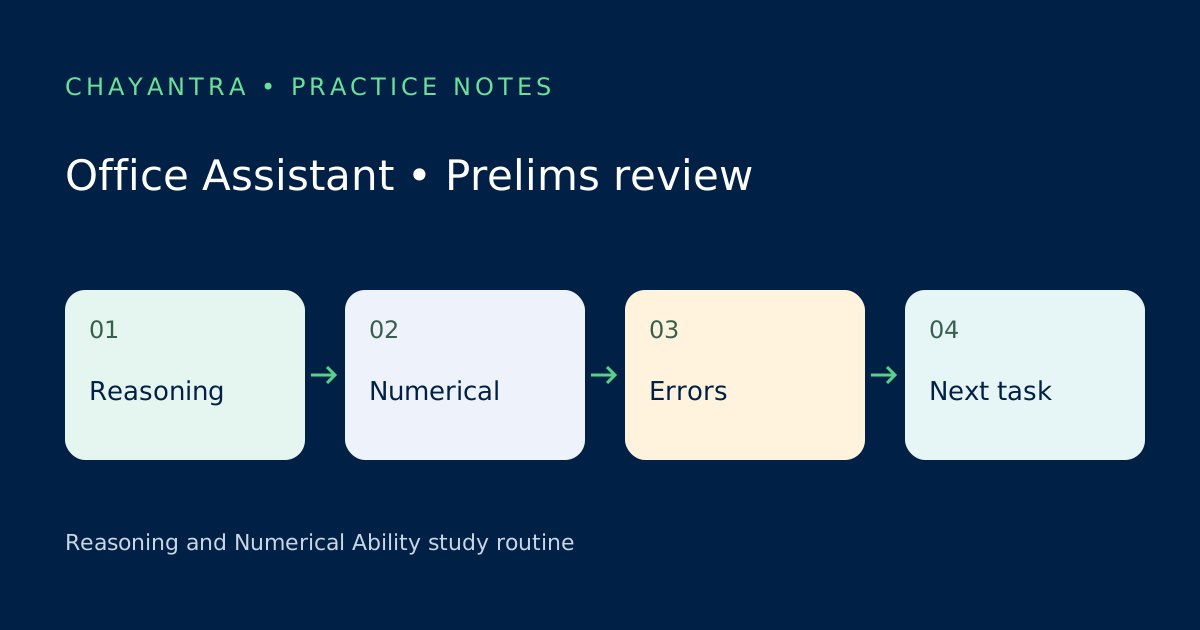
For an IBPS RRB Office Assistant Prelims preparation routine, plan Reasoning and Numerical Ability practice, review the cause of errors after each set, and use a relevant mixed paper to check whether the corrections transfer. Keep Office Assistant separate from Officer Scale I, and Prelims separate from Mains. An English topic test is not a replacement for an Office Assistant Prelims paper.
Check the applicable current notice on the IBPS website for the subject requirements and rules of your target stage. No current registration deadline, question total, marking rule or section duration is asserted here. Use the notice and any corrigenda for those facts. A platform practice title and its timing settings are not evidence of an official rule.
Start by naming the exact target
Write “Office Assistant — Prelims” at the top of your study plan. Do not rely on the broad label “banking” when selecting questions. Office Assistant and Officer Scale I are distinct recruitment roles; a paper labelled “PO” or Officer Scale I should not be silently substituted for an Office Assistant paper. Mains preparation has a different scope and should be planned from the relevant official notice.
Before starting an online set, read the role, stage, question count, duration, marking and review coverage actually shown. If the title is ambiguous, use a subject exercise for the named skill or ask for clarification. Do not treat a miscellaneous Banking catalogue as proof that a specific Prelims simulation is available.
The rest of this guide explains an adjustable practice routine. Its sample time allocations and examples are teaching suggestions, not official exam timings or a prediction of how many marks a topic will earn.
Diagnose Reasoning errors by the failed step
After a reasoning set, record whether you missed a condition, placed information incorrectly, made an invalid inference, or spent too long pursuing an arrangement. A wrong final answer does not identify which step failed. Rebuild your working until you can point to the first unsupported move.
Consider this original direction exercise: “Maya walks 3 km north and then 4 km east. What is the shortest straight-line distance from her starting point?” The path travelled is 7 km, but the requested straight-line distance is the hypotenuse of a right triangle: √(3² + 4²) = 5 km.
If you answered 7 km, check whether you confused distance travelled with displacement. If you drew the correct triangle but computed the square root incorrectly, the cause is calculation. If you reversed north and east while reading, review the diagram step. Each diagnosis needs a different correction. This small exercise illustrates a method; it is not a claim that a particular question will appear in an exam.
Diagnose Numerical Ability errors by setup and calculation
Suppose a shop's sales increase from ₹800 to ₹920. The increase is ₹120; relative to the original ₹800, the rise is 120 ÷ 800 × 100 = 15%. Dividing by ₹920 would answer a different comparison. Record “wrong original base” if that was your error, rather than writing only “percentages”.
Now check a fresh reverse example: a fall from ₹920 to ₹800 is 120 ÷ 920 × 100, approximately 13.04%. The same rupee change does not produce the same percentage because the starting values differ. Explain that relationship before attempting speed drills.
If the setup is right but arithmetic is slow, practise a smaller calculation set with clear working. If both are weak, fix the setup first. Avoid memorising one numerical answer and mistaking recognition for mastery.
Use a repeatable practice-and-review cycle
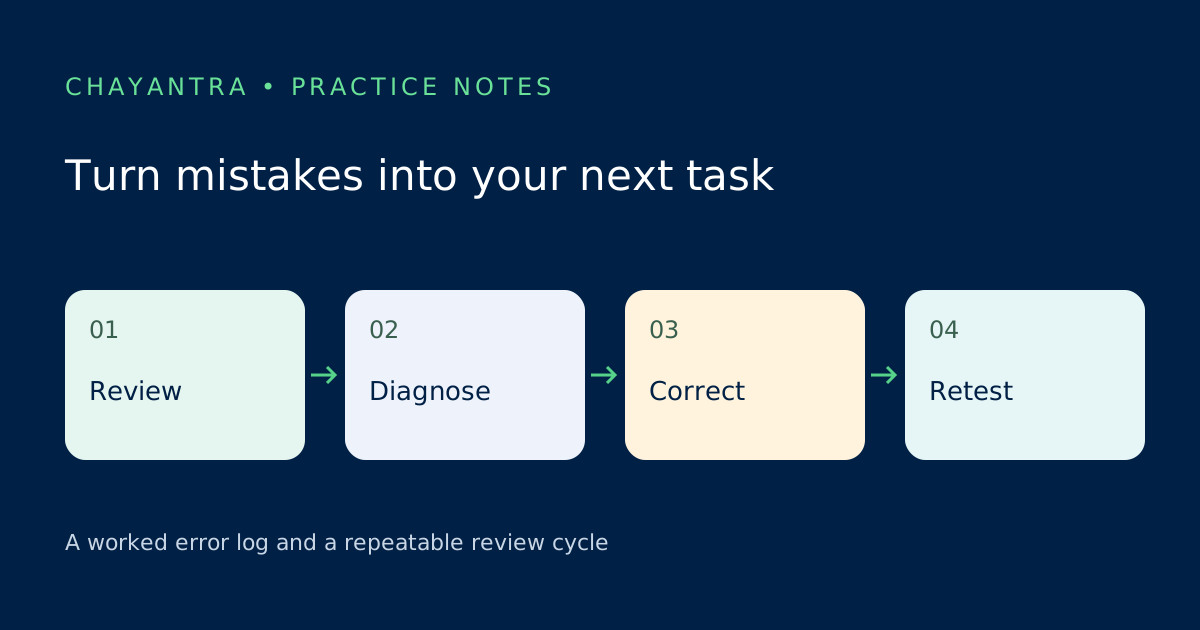
A useful cycle has four parts: choose a narrow skill, attempt a manageable fresh set, explain the errors, and retest one correction later. Keep correct-but-guessed questions in the review list. If you only review wrong answers, a lucky guess can hide a weakness.
For an illustrative 50-minute study session, you might spend 20 minutes on Reasoning, 20 on Numerical Ability and 10 recording corrections. If one subject needs more concept work, try a 25/15/10 split instead. These are study budgets, not section locks or recommendations about official in-exam time allocation. Adapt them to your stage, available time and diagnostic evidence.
Do not end a session with only “take another test” as the next action. A concrete note might be “redo the condition diagram without the solution, then solve one fresh arrangement” or “identify the original value before calculating percentage change”. The mock-test error log provides space for these actions and review dates.
A sample week that changes with your results
| Session | Reasoning focus | Numerical focus | Review decision |
|---|---|---|---|
| First | Diagnose a small set | Diagnose a small set | Choose one cause in each subject |
| Second | Correct the reasoning step | Rebuild the numerical setup | Explain both without notes |
| Third | Try fresh questions | Try fresh questions | Retain unresolved errors |
| Fourth | Mix familiar skill types | Mix familiar skill types | Add timing only if methods are stable |
| Fifth | Use a relevant available paper when ready | Review its actual subject split | Plan the next cycle from new evidence |
These are sessions, not compulsory consecutive days. If a concept remains unclear, repeat the learning step rather than adding more timed attempts. If you have less time, shorten the set while preserving review. Completing a schedule is less informative than being able to explain a fresh answer independently.
Review uncertain answers and question choice
Track wrong, skipped and uncertain-correct answers separately. For a difficult puzzle, record whether you could recognise that it needed more time. For a numerical item, ask whether estimation could have exposed an impossible answer. Keep your next strategy within the navigation and timing rules of the actual test you are taking.
Chayantra practice uses an overall deadline; leaving an attempt does not pause that deadline. See the help desk for saving and resuming answers. Use the negative-marking guide for reasoning about uncertainty, while checking the actual paper's scoring rules. No guessing rule guarantees a positive result.
Select the next paper honestly
The Banking practice catalogue is a directory: inspect each card for the exact role and stage before starting. A matching Office Assistant Prelims CTA should appear only when the current published catalogue confirms a suitable paper. If none is available, use relevant standalone subject work with its narrower scope disclosed; do not relabel it as a full mock.
The banking DI and puzzle guide offers related study ideas, but its broad category is not a stage guarantee. The IBPS RRB exam guide is a secondary orientation page; follow IBPS's current notices and corrigenda for authoritative facts. Review what you can now solve, what still requires help, and which precise exercise will test the next correction.