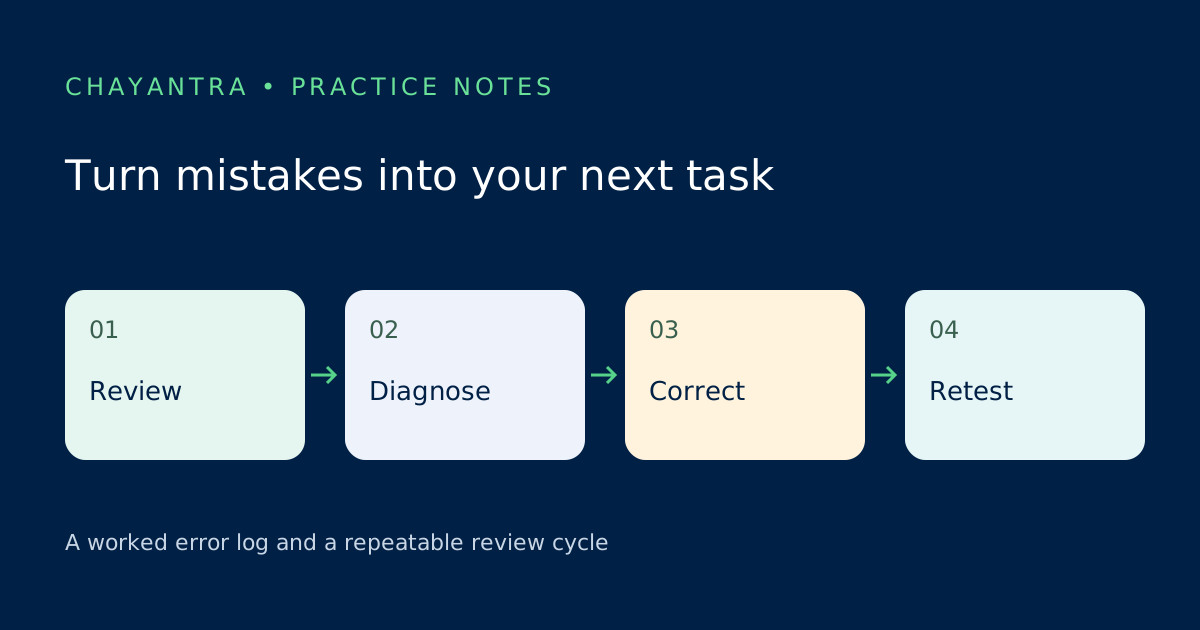
Analyse a mock by finding the reason behind each lost or uncertain answer, correcting that reason, and testing it again on fresh questions. Your score tells you where you finished; an error log tells you what to practise next. Start with one repeated weakness you can act on today, rather than taking another full paper immediately.
This guide gives a five-step review method and a worked error log. The examples are invented for teaching, not records of Chayantra learners. The method works with a paper answer key or an online review screen. Where a paper provides answers without explanations, consult a trusted explanation or teacher before recording a rule as settled.
Step 1: Reconstruct the attempt before studying solutions
Record the paper name, date, question count, attempted questions, correct answers and incorrect answers. Keep the paper's actual marking scheme beside these numbers. Do not compare raw marks from papers with different lengths or penalties. An accuracy calculation uses correct answers divided by attempted answers; skipped questions belong in a separate count.
Imagine a small practice exercise with 20 questions. You attempted 15, got 10 correct, got 5 wrong and skipped 5. Attempt accuracy is 10 ÷ 15, about 67%; coverage is 15 ÷ 20, or 75%. Neither number tells you why you lost answers. If you attempted more by guessing, coverage might rise while accuracy falls. Keep both measures so that a rushed attempt does not look like improvement merely because more questions were touched.
Before opening solutions, mark answers you guessed or felt uncertain about. A lucky correct answer needs review too. If question-level time is not available, use honest notes such as “spent too long on this puzzle”; do not invent precise seconds from memory.
Step 2: Give each mistake a useful diagnosis
Use the smallest explanation that would change your next action. “Careless” is too broad: it does not tell you what to fix. One primary category and, if helpful, one secondary category are enough.
| Error type | What it looks like | A corrective action |
|---|---|---|
| Concept | You cannot explain the rule even without a timer | Learn the rule, then solve a fresh example |
| Reading | You miss “except”, a unit, or a condition | Restate the question in a short sentence |
| Calculation | Your setup is right but arithmetic fails | Repeat the calculation and check by estimation |
| Speed | You know the method but execution is slow | Practise a small set after accuracy is stable |
| Question choice | One difficult item consumes time needed elsewhere | Practise leaving and returning within permitted navigation |
| Guessing | You choose without enough evidence | Record why the remaining options were not eliminated |
Classify the cause, not just the subject. Two percentage errors may require different fixes: one learner used the wrong base; another copied a digit incorrectly. Giving both “revise percentages” wastes the opportunity to make the correction precise.
Step 3: Work through the correction yourself
Suppose a price rises from ₹200 to ₹250. An invented learner calculates 50 ÷ 250 and writes 20%. The increase is ₹50, but the comparison base is the original ₹200. The percentage increase is 50 ÷ 200 × 100 = 25%. This is a concept error about the base, not evidence of slow calculation.
Write the transferable rule: “For percentage change, divide the change by the original value.” Then test it on a fresh example: a fall from ₹80 to ₹60 is a decrease of ₹20 on a base of ₹80, or 25%. If you can only repeat the first solution, you have not yet shown that the rule transfers.
For a reading error, imagine a question asking which statement is NOT supported. Selecting a supported statement may indicate that you answered the opposite task. The correction is to restate “find the unsupported claim” before comparing choices. It is not necessary to reread an entire chapter when the underlying concept was already understood.
Step 4: Build an error log you will actually revisit
Record a reference to the question rather than copying a private question bank into a public document. The question reference should help you return to your own attempt. Avoid putting names, passwords or personal identifiers into shared worksheets.
| Question / topic | Type | What happened | Correction | Next practice | Review date |
|---|---|---|---|---|---|
| Fictional Q7 / percentage change | Concept | Divided by the new price | Use the original value as the base | Two fresh percentage-change examples | Choose a date |
| Fictional Q12 / reading | Reading | Missed NOT | Restate the requested task | One evidence-based reading question | Choose a date |
Use the editable mock-test error log to fill, copy, export or print your own version. A blank entry can also be copied from this template:
Question/topic: ____. Error type: ____. My reasoning: ____. Correct reasoning: ____. A fresh question to try: ____. Review date: ____. Retest result: ____.
Keep the log short enough to review. Ten copied solutions without a next action are less useful than three entries that identify a repeatable mistake and a fresh check. Combine repeated entries once they clearly share the same cause, but keep unusual errors that need different treatment.
Step 5: Choose the next practice and close the loop
If you cannot solve a question without a timer, return to the concept first. If you solve it accurately without a timer but struggle under time, use a short timed set. If the method is sound but you chose questions poorly, use a mixed set to rehearse selection. A new full mock is useful when you want to check how several corrections work together.
Try a short recall check the next day and another later in the week, adjusting the interval to your available time and the difficulty of the skill. These intervals are suggestions, not an exam rule. At each check, explain the method without looking and attempt something unfamiliar. Repeated questions can help recall but may overstate readiness through memory.
Mark an entry “needs work”, “correct with help”, or “correct independently”. Move it out of your active list only after a fresh check supports that decision. If the same error returns, inspect the cause again rather than adding another vague instruction to “be careful”.
A practical review checklist
- Count wrong, skipped and uncertain-correct answers separately.
- Choose one repeated cause that affects several questions.
- Write the correct reasoning in your own words.
- Try a fresh question without the solution visible.
- Schedule a short recheck and decide whether the next task needs timing.
Use available mock papers when you are ready to test combined skills, or the subject directory for a narrower weakness. For guessing decisions, read negative marking and calmer answer choices. If recall is your main issue, the current-affairs revision guide offers a related study routine. This method cannot promise a particular score gain; its useful output is a specific, testable next action.