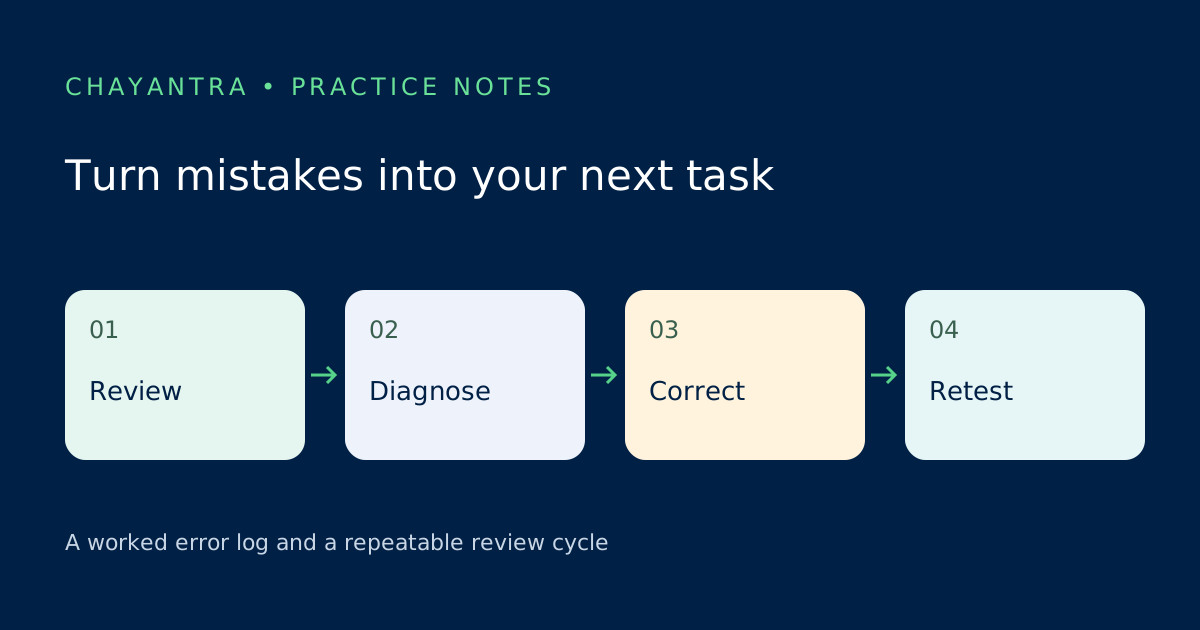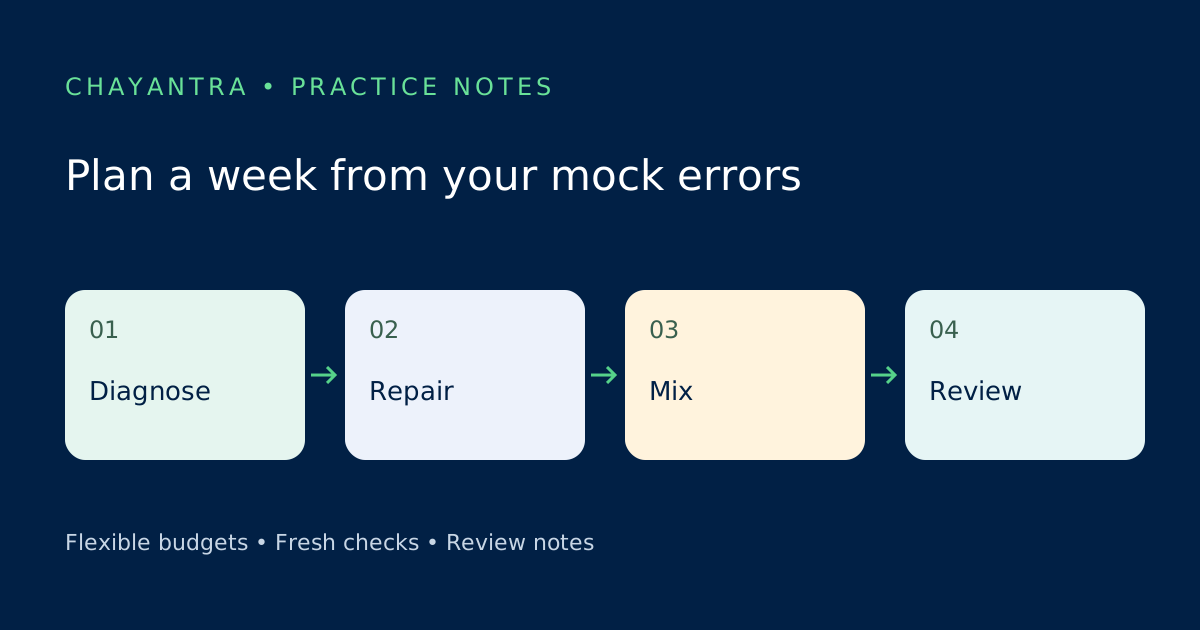
Build a seven-day CHSL revision plan from your latest practice errors: identify two recurring weaknesses, assign a correction and a fresh check to each, then use a mixed attempt to see whether those corrections transfer. Keep the schedule adjustable. A plan that fits your available time is more useful than a fixed number of daily hours you cannot sustain.
This is a study-planning guide, not a notification summary or a promise of a score increase. Confirm your target stage and current syllabus through the Staff Selection Commission before choosing material. Use the applicable official notice for the current pattern, dates and timing rules. Chayantra's practice-paper instructions describe that paper; they should not be assumed to reproduce every official exam condition.
Diagnose the week before filling the calendar
Use one recent, relevant practice attempt as a starting point. Separate incorrect answers, skipped questions and uncertain correct answers. Within each subject, identify the cause: a concept gap, reading mistake, calculation error, recall gap, slow method or poor question selection. “English is weak” is not specific enough to assign a useful task. “I let the plural noun inside a phrase control a singular verb” is.
An illustrative learner might find three percentage-base mistakes, two subject–verb agreement errors and several general-awareness answers that cannot be recalled without options. These are fictional diagnostic notes, not a student's reported results. They suggest three different actions: rebuild a calculation method, inspect sentence structure, and retrieve facts without prompts.
Do not choose priorities only by the number of errors. Ask whether the weakness repeats, whether it affects other topics, and whether the correction is manageable this week. If an answer key is disputed or lacks an explanation, mark that question unresolved until a trusted source or teacher can check it. Do not build the week around an uncertain “rule”.
Set a flexible study budget
Choose a realistic daily window and divide it among correction, fresh practice and review. For an illustrative 45-minute session, try 15 minutes revisiting a method, 20 minutes attempting relevant questions and 10 minutes recording the result. These are suggested study allocations, not official section durations. With less time, reduce the question set and keep the review. With more time, add a second short task after checking the first.
On a day when you are tired or interrupted, a short recall check may be more useful than a full paper started without enough time to finish. The platform's overall attempt deadline continues while you are away; saved answers do not mean the clock pauses. Read the paper instructions and the help desk before beginning a timed attempt.
A seven-day plan with a purpose for every day
| Day | Main task | Fresh check | What to record |
|---|---|---|---|
| 1 | Diagnose one relevant mock; choose two priorities | Explain one missed method without the key | Error cause and next action |
| 2 | Rebuild priority one, such as percentage bases | Solve a small unfamiliar set accurately | Correct / attempted; repeated cause |
| 3 | Rebuild priority two, such as agreement | Explain both the chosen and rejected options | Rule used; uncertain answers |
| 4 | Revisit a recall or reading weakness | Retrieve facts or justify passage evidence | What you knew without prompts |
| 5 | Mix the corrected skills | Try a short timed set within its stated rules | Accuracy and timing separately |
| 6 | Attempt an available relevant paper if ready | Apply your question-selection plan | Wrong, skipped and uncertain-correct items |
| 7 | Review transfer and plan the next week | Retest unresolved errors on fresh material | Keep, change or retire each priority |
Use the editable seven-day revision planner to replace the examples with your own topics and time budget. A missed day does not require doubling the next day's work. Move the most useful unfinished task and reduce the scope.
Day 2 example: repair the method before adding speed
Suppose you treated a rise from ₹400 to ₹500 as a 20% increase because you divided the ₹100 change by ₹500. Use the original value as the comparison base: 100 ÷ 400 × 100 = 25%. For a fall from ₹500 to ₹400, the base is now ₹500, so the decrease is 20%. Equal rupee changes can produce different percentage changes because the bases differ.
Write two new examples and explain the base aloud or in a sentence. Only add a time budget after the setup is reliable. If you rush the same misconception, more questions may reinforce it. Record a calculation slip separately from a base-selection error so that your next action stays precise.
Day 3 example: make grammar revision diagnostic
Compare “The bundle of forms is ready” with “The forms are ready”. In the first, “bundle” controls the verb; in the second, “forms” does. A useful review task is to locate the subject in fresh sentences and explain agreement, rather than repeatedly recognising the answer to the same item.
Use the English topic hub to inspect available practice. The name of a topic is a starting point, not proof that every set covers your exact weakness. Check the contents and answer-review coverage. For recall-based work, the current-affairs revision guide describes a related routine; verify time-sensitive facts against current sources.
Day 6: decide whether a mock is the right next task
If both priorities remain unclear without a timer, use the day to finish concept work and postpone the full attempt. If short-set accuracy is stable but performance falls when topics are mixed, a relevant mock can reveal whether recognition or question choice is the problem. Pick a paper from the published mock catalogue and read its actual specifications.
Follow the platform's stated overall countdown and permitted navigation. Suggested pacing is a planning aid, not a promise of enforced section timers. Where a paper is labelled answer-key-only, allow time to obtain trustworthy explanations for disputed questions. Do not assume all papers have the same review coverage.
Day 7: measure changes you can interpret
Compare like with like: topic, difficulty, number of questions and conditions matter. If a small set moves from six correct out of ten attempted to eight out of ten, that is an observation about those sets, not proof that your final exam score will rise by the same amount. Keep notes about whether the second set was new or familiar.
Choose next week's priorities from remaining recurring errors. Retain a weakness if the same cause returns; narrow it if only one part remains; retire it from the active list after a fresh independent check. The mock error log keeps that decision visible, and the negative-marking guide helps review uncertain choices. Your week's output should be a smaller, clearer set of problems to solve next, with evidence for what improved.
Connect the pattern with your next attempt
Read the SSC CHSL exam-pattern guide to separate stage requirements from practice settings. Then choose a published CHSL mock or target a specific weak skill.