The SSC CHSL exam pattern tells you what to prepare, how questions are scored and which parts of the selection process require a different kind of practice. Begin with Tier-I's four subjects, then plan separately for Tier-II's objective components, computer knowledge and the post-specific skill or typing test. A multiple-choice mock alone does not train every stage.
This guide explains the scheme in the SSC CHSL 2026 notice, with preparation examples rather than a prediction of questions. The linked official notice and subsequent SSC updates take precedence. For application information, use the CHSL exam overview. To act on the pattern now, choose a published CHSL mock test or a focused topic test.
SSC CHSL Tier-I pattern at a glance
The notice lists 100 objective questions for 200 marks. Each subject contributes 25 questions and 50 marks. The standard duration is 60 minutes, with a 15-minute sectional timer per subject in the cited 2026 scheme. The notice provides a different timing arrangement for eligible candidates using a scribe; check the applicable eligibility paragraphs rather than assuming that arrangement applies to everyone.
| Subject | Questions | Maximum marks | Standard sectional time in the cited notice |
|---|---|---|---|
| English Language (Basic Knowledge) | 25 | 50 | 15 minutes |
| General Intelligence | 25 | 50 | 15 minutes |
| Quantitative Aptitude (Basic Arithmetic Skill) | 25 | 50 | 15 minutes |
| General Awareness | 25 | 50 | 15 minutes |
| Total | 100 | 200 | 60 minutes |
Source: the SSC CHSL notification, paragraphs 13.8–13.8.2. Subject names here describe coverage, not a promise about the order in which your examination will present them. Parts II, III and IV have language provisions stated in the notice; consult the actual application/notification rules for your selected language.
Marking: calculate your practice score correctly
For the cited Tier-I scheme, a correct answer earns 2 marks and an incorrect answer loses 0.50 marks. Use the marking rules of the actual paper when reviewing an attempt. A raw correct-answer count and a final score are different measures.
Consider an invented example: 70 correct answers, 20 wrong answers and 10 unattempted questions. The calculation is 70 × 2 − 20 × 0.50 = 130 marks. Attempt accuracy is 70 ÷ 90, approximately 77.8%; the denominator is attempted questions, not all 100. The unattempted count helps you distinguish a coverage issue from an accuracy issue. This is a worked calculation, not a learner result or a predicted cutoff.
A second fictional attempt with 65 correct, 10 wrong and 25 unattempted would score 125. It has higher attempt accuracy but a slightly lower score. Neither example proves that attempting more or attempting less is always better. Review the reasons for uncertainty, the paper's penalty and the available time. Read negative marking and calmer answer decisions for a fuller decision framework.
What changes in Tier-II?
The cited notice describes Tier-II in two sessions. Session-I contains Mathematical Abilities, Reasoning and General Intelligence, English Language and Comprehension, General Awareness, and Computer Knowledge. Session-II contains the post-specific Skill Test or Typing Test. Do not carry Tier-I's four equal subject allocations into every Tier-II task.
| Tier-II component | Questions in the cited scheme | Marks | Preparation implication |
|---|---|---|---|
| Section-I: Mathematical Abilities + Reasoning and General Intelligence | 30 + 30 | 180 | Build methods and use the section's actual timing rules |
| Section-II: English Language and Comprehension + General Awareness | 40 + 20 | 180 | Prepare the unequal subject allocation |
| Section-III: Computer Knowledge Test | 15 | 45 | Prepare separately; the notice treats it as qualifying |
| Section-IV: Skill Test / Typing Test | Post-specific task | Qualifying requirements in the notice | Practise the required typing/data-entry task itself |
The standard Session-I duration in the notice is 2 hours 15 minutes, with component timings detailed in its table. The notice specifies a 1-mark penalty for wrong answers in Sections I–III. Do not apply Tier-I's 0.50 deduction to those components. Qualifying requirements, skill/typing standards, scribe provisions and post-specific conditions need their own reading. Source: paragraphs 13.9 onward of the notification.
Turn the four Tier-I subjects into practice tasks
For English, identify a narrower weakness: agreement in sentence correction, evidence in reading comprehension, vocabulary in context, or sentence links in para jumbles. Work through similar sentence-correction options and the reading-comprehension evidence guide, then inspect published English sets. A familiar topic label does not prove that every set trains the exact weakness you found.
For Quantitative Aptitude, separate choosing the method from performing the calculation. If a price rises from ₹200 to ₹250, the increase is ₹50 on the original ₹200: 25%. Dividing by the new ₹250 answers a different comparison. Practise that setup correctly on fresh examples before adding speed. The CHSL practice hub's topic section lists relevant currently published sets where available.
For General Intelligence, review the first unsupported step in your reasoning, rather than only memorising the final option. A Critical Reasoning set is not automatically a substitute for the complete General Intelligence syllabus. Check each exercise's actual scope, and use a relevant full paper to practise switching between question types.
For General Awareness, distinguish recall from recognition. After reviewing a fact, try retrieving it without options and verify time-sensitive information against a suitable current source. The current-affairs revision guide explains a recall routine. Available awards, books or dates exercises are narrower practice, not complete syllabus coverage.
Official sectional timing and Chayantra practice timing
The cited official scheme describes sectional timing. Chayantra's current practice engine uses one overall deadline with free movement between sections and suggested pacing. Section-duration metadata or a paper description should not be taken to mean that the platform locks a section when that interval ends.
Use a separate section-pacing note when practising to an official time allocation, and read the instructions of the paper before starting. If you leave an attempt, its overall deadline continues; saved answers do not pause the clock. The help desk explains that behaviour. This distinction helps you use a practice paper appropriately without treating it as an exact simulation of every official interface rule.
Build a revision week from the result
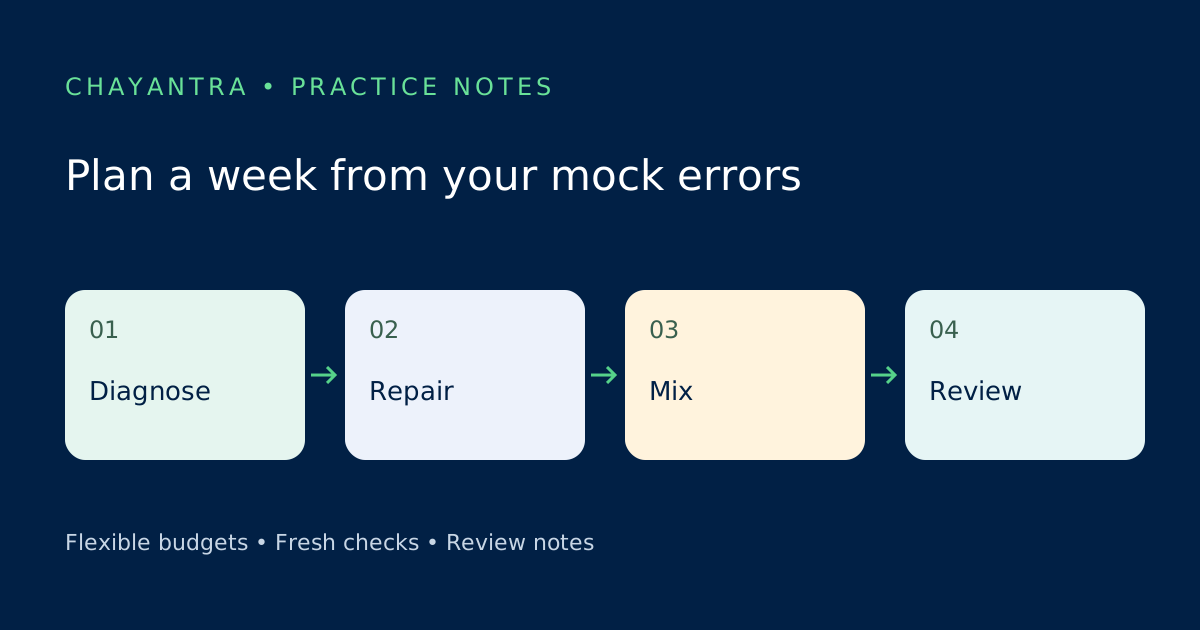
Start with one relevant mock, record wrong, skipped and uncertain-correct questions, and choose two repeated error causes. Repair those causes in short topic sessions, check fresh questions and then use another mixed attempt when ready. The seven-day CHSL revision guide turns that sequence into an adjustable schedule.
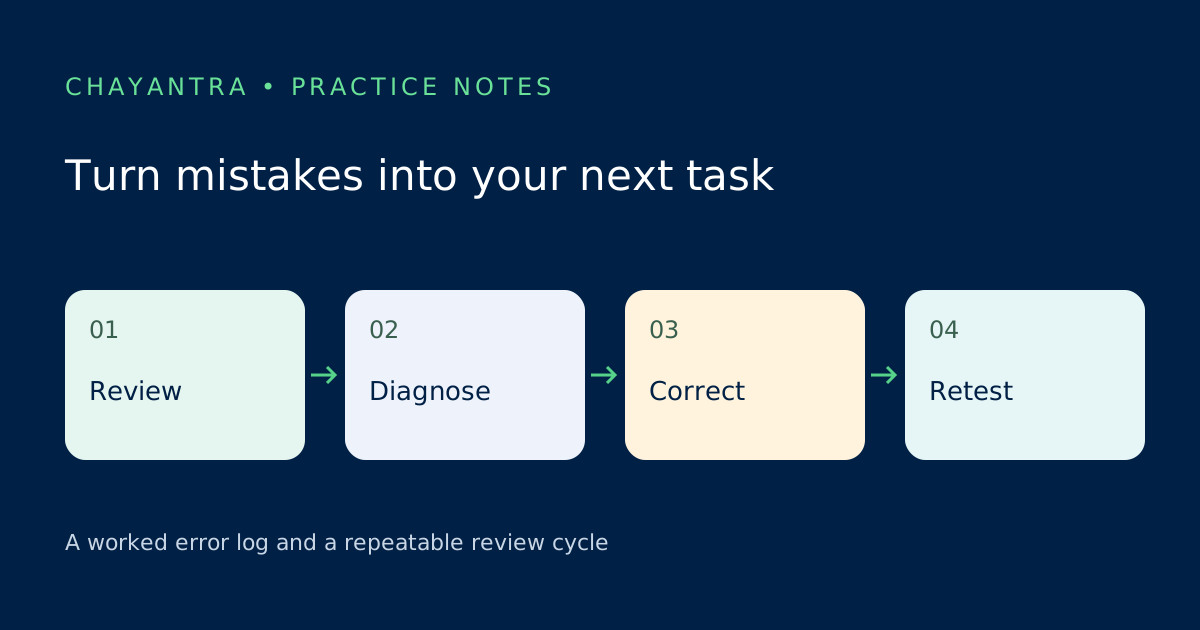
Use the editable CHSL planner for your time budget and the mock-test error log for causes, corrections and retest dates. Your next practice should answer a question about your learning: can you explain the method, apply it accurately, or execute it within a suitable budget? Taking another mock immediately is useful only if it checks something you have worked on.
Common questions about the CHSL pattern
Does an exam-pattern page replace the official notice? No. Use the linked scheme to understand the structure, and check later official notices for amendments and instructions. This guide does not announce an exam date, vacancy total or cutoff.
Does one 100-question practice paper prepare every stage? No. It can help diagnose the skills covered by that paper. Tier-II and the applicable skill/typing task require their own preparation. Chayantra's CHSL papers are labelled Tier-I practice; no Tier-II mock is promised by this page.
Where should I start if my accuracy is low? Find one recurring cause in an earlier attempt, study a worked explanation and use a relevant topic test. When the method is stable, return to a CHSL mock to check transfer across subjects.
Do all Chayantra papers include worked explanations? No. Read the paper-specific review label. Some published CHSL papers have an answer key only; others have worked explanations where supplied. An answer-key-only paper may need an additional trusted explanation during review.
Sources and next step
Pattern source: SSC CHSL 2026 notification, specifically the scheme of examination in section 13. Consult the official SSC notice board for later notices and corrigenda. Source checked on 29 October 2026: the SSC-hosted notification and the notice-board entry for the 7 September 2026 notice; they do not establish that every future amendment has already been incorporated.
Choose your next action: compare available CHSL practice papers, work on a specific topic, or plan your next revision week.