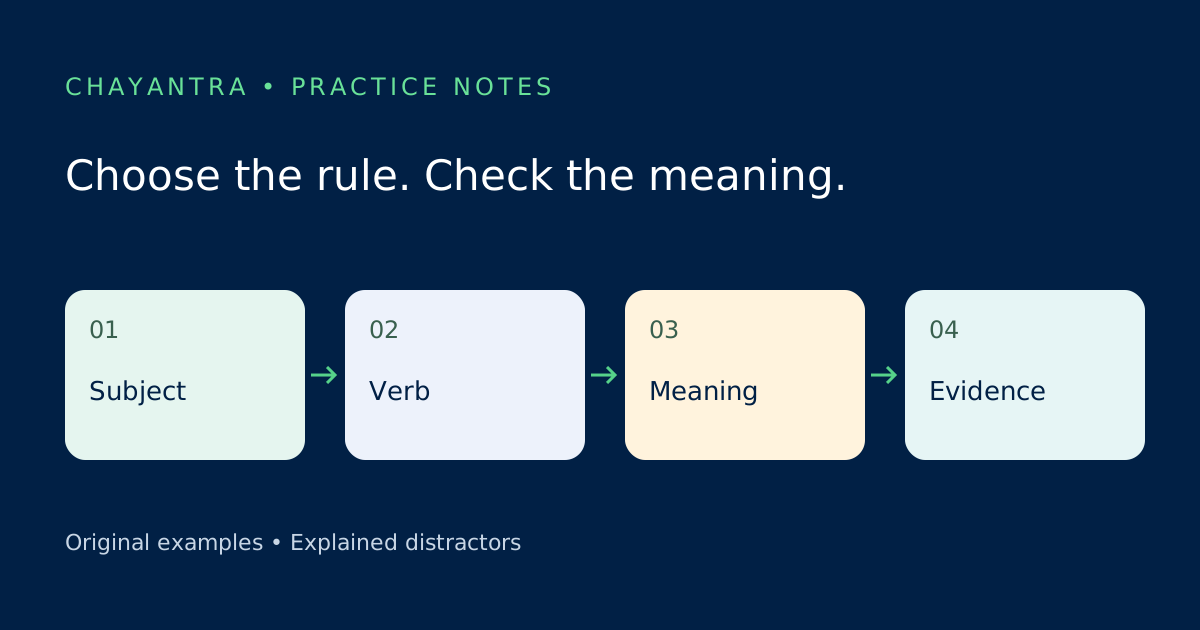
When sentence-correction options look similar, identify the grammatical relationship that differs before choosing the sentence that sounds most familiar. Find the subject and verb, check the intended time, and compare the words that the options change. Eliminate an option for a stated reason, then reread the whole sentence for meaning.
The examples below are original teaching examples. They focus on formal written English and use context to make the intended answer clear. They are not official previous-year questions or reproductions of a private practice bank. Some real sentences permit more than one construction; if an item lacks enough context, seek clarification instead of inventing a universal rule.
Agreement: locate the subject, not the nearest noun
Choose the completion: “The list of revised instructions ___ on the desk.” Options: A, are; B, is; C, have; D, were. The intended present-tense answer is B: “The list of revised instructions is on the desk.”
The subject is “list”, which is singular. “Of revised instructions” describes that list; its plural noun does not control the verb. A uses plural agreement. C cannot complete this sentence as written. D changes to a plural past form without matching the singular subject. Bracket the modifying phrase and read “The list is on the desk” to check the structure.
Do not turn this into “always use the noun nearest the start”. Instead ask what the sentence is making a statement about. Nor should you assume every word ending in “s” is plural. Sentence correction tests relationships, not a single surface clue.
Tense: use the time reference provided
“By the time the meeting began, Kavya ___ the report.” Choose A, has finished; B, had finished; C, will finish; D, finishing. B places the completed report before another past event. “Had finished” fits the supplied sequence.
A connects a past completion to the present and does not fit this exercise's past viewpoint as well. C points forward from the present rather than locating the earlier completion. D is not a complete finite verb phrase in this slot. The useful reasoning is a small timeline: finish report → meeting begins. Do not apply a memorised tense combination when the surrounding sentence establishes a different sequence.
A practical check is to underline time expressions first. If two options remain grammatically possible, ask whether they say the same thing. A choice can be grammatical in isolation while failing to convey the specified relationship.
Modifiers: identify who performs the action
Compare: A, “Walking into the library, the notice caught Riya's attention.” B, “Walking into the library, Riya noticed the sign.” B clearly attaches the opening action to Riya. In A, the grammatical subject following the introductory phrase is “the notice”, making the attachment misleading.
The repair is not simply to delete every introductory phrase. Keep the intended doer as the subject: “As Riya walked into the library, the notice caught her attention” also states the relationship clearly. In a multiple-choice item, examine both grammar and whether the revision preserves the intended event.
Use the question “Who was walking?” to diagnose the fault. For longer sentences, draw a quick connection between the modifier and the noun it describes. A sentence can contain familiar words and still attach information to the wrong person or object.
Comparisons: compare like with like
“The population of Town A is larger than ___.” A, Town B; B, that of Town B. B explicitly compares the population of one town with the population of the other. A, as written in this formal comparison exercise, compares a population with a town.
“That” replaces the singular “population”. In a comparison involving plural items, a different replacement may be needed. Read both sides of “than” in full to test whether the comparison is balanced. Do not choose “that of” automatically just because it appears in an option; first establish what it stands for.
Parallelism: keep equal items in equal forms
“The workshop teaches learners to plan a response, check evidence, and ___ clearly.” A, writing; B, write; C, written; D, to writing. B continues the sequence after “to”: plan, check and write. The actions have the same grammatical role.
A changes the third item to an -ing form without changing the first two. C supplies a participle rather than the needed base form. D does not fit the infinitive construction. Another valid sentence could use three -ing forms: “The workshop covers planning, checking and writing.” The lesson is consistency within a construction, not a ban on -ing words.
Prepositions: consider the whole expression
“In this exercise, compare two activities: Neha prefers revising in the morning ___ studying late at night.” A, than; B, to. B fits “prefers X to Y”, with the two activities expressed in parallel -ing forms.
Do not generalise that every expression of preference uses the same construction. “Would rather revise than guess” uses a different pattern. When reviewing a mistake, write the entire expression and a fresh sentence, not an isolated list of prepositions. This helps distinguish a learned construction from a word association.
A five-check decision routine
- State the intended meaning in plain language.
- Locate the main subject and finite verb.
- Find the specific difference between the remaining options.
- Name the rule or meaning change that eliminates each option.
- Reread the complete chosen sentence, including words outside the edited part.
If a pair remains unresolved, record the uncertainty. Looking up one well-chosen example after practice is more productive than silently converting a guess into a rule. Use the English revision checklist to connect a recurring mistake with the next skill to review.
Mini self-test: explain before checking
- “Each of the folders (contain / contains) a summary.”
- “The team aims to reduce errors, improve clarity, and (save / saving) time.”
- “Before the guests arrived, we (had arranged / will arrange) the chairs.”
Answer 1: “contains”. “Each” is singular in this construction; “folders” belongs to the “of” phrase. Answer 2: “save”, keeping the three actions parallel. Answer 3: “had arranged”, placing the arrangement before the stated past arrival. For each, say why the competing option fails before moving on.
Now change one detail and solve again: “The folders contain summaries” requires plural agreement. This checks the relationship rather than recall of a single answer. Keep error notes in the mock error log, and consult English topic practice for the currently published sets. Check a set's title, exact length and review coverage before starting. The negative-marking guide is useful when deciding whether your elimination has enough support; the help desk explains the platform's attempt and timing behaviour.