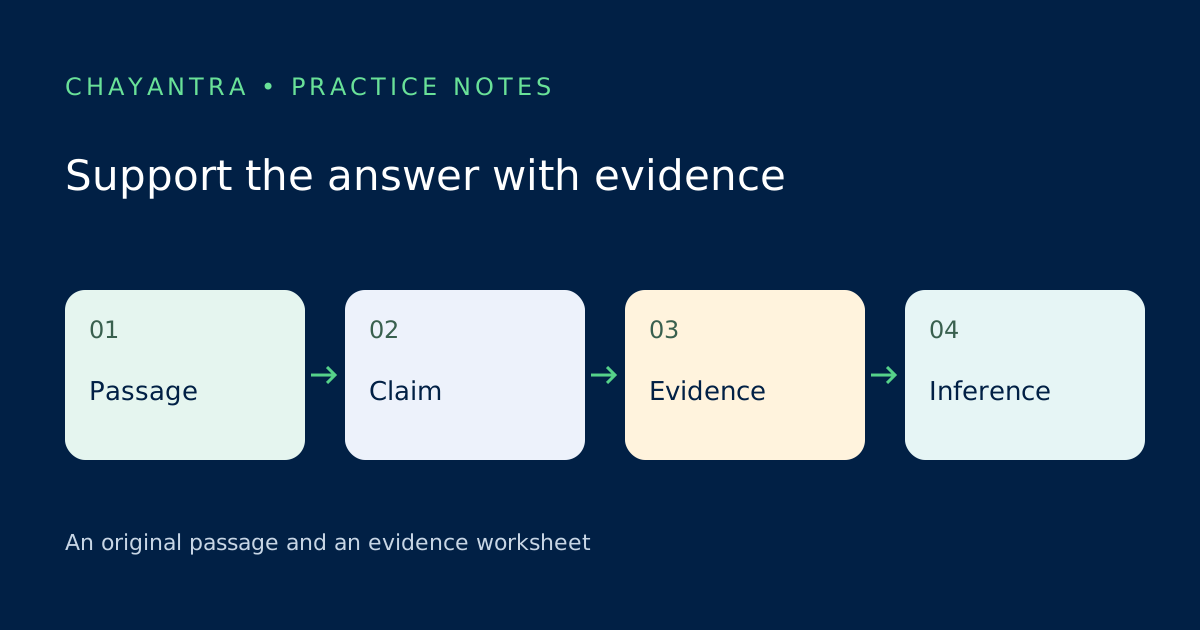
An inference answer should follow from the passage without requiring a new fact. Find the words that support the choice, preserve the writer's qualifications, and reject options that turn “some” into “all” or association into proof of a cause. A plausible statement about the world is not automatically a supported answer to this passage.
Use the original passage and three questions below to practise that distinction. The people, place and observations are fictional. The passage was written for this guide, not copied from a test bank. It is a reading exercise, not research evidence about libraries or transport.
Original passage: a library changes its hours
[1] For six weeks, a neighbourhood library kept its reading room open for an extra hour on Tuesdays and Thursdays. [2] Staff recorded more evening visits on those days than in the previous six weeks, but did not ask visitors why they came. [3] A nearby bus route also began running later during the trial. [4] In a voluntary feedback box, several visitors welcomed the extra hour, while others asked for quieter seating. [5] The manager proposed continuing the trial for another month and collecting comments from visitors who arrived in the final hour. [6] She cautioned that evening visit counts alone could not show whether the longer hours caused the increase.
First read for the passage's movement: a change, an observation, another possible influence, mixed feedback, a proposed next step, and a limit on the conclusion. You do not need to memorise every word. You need a map that lets you return to the relevant sentence.
Question 1: what does the evidence justify?
Which conclusion is best supported?
- A. The extended hours were the sole cause of the increased visits.
- B. More evening visits were recorded, but the reason for the increase was not established.
- C. Most residents now prefer the library to other study spaces.
- D. The trial failed because some visitors wanted quieter seating.
B is supported by sentences 2 and 6. The visits increased, but the library did not establish why. Sentence 3 also introduces a change that could matter, without proving that it did matter.
A adds both causation and “sole”; the passage explicitly cautions against that conclusion. C invents a comparison with other study spaces and a claim about most residents. D converts a request for quieter seating into a verdict of failure. The passage reports mixed feedback, not a predefined success criterion or a failed result.
Write the evidence before the answer letter: “2 + 6: increase recorded; cause unknown.” This short note helps expose an unsupported jump. Copying the whole passage is unnecessary.
Question 2: infer the manager's approach
Which description best fits the manager's proposal?
- A. She treats the first counts as final proof that no further information is needed.
- B. She wants to stop gathering feedback because the comments disagree.
- C. She treats the initial evidence as incomplete and wants more relevant feedback.
- D. She believes every visitor used the later bus service.
C follows from sentences 5 and 6: continue the trial, ask a more targeted group, and acknowledge what the counts cannot establish. A contradicts the planned collection of more comments. B reverses her decision. D adds a belief never expressed.
Notice the difference between “wants more information” and “will prove the cause next month”. The latter is stronger than the text. Even the planned feedback would have limits. A correct inference should not promise an outcome the author has not supplied.
Question 3: supported detail or outside assumption?
Does the passage establish that all visitors arriving in the final hour travelled by bus? No. It mentions a later bus route and proposes gathering comments from late visitors, but never joins those facts into a statement about everyone's journey.
A tempting answer may borrow two real details and connect them incorrectly. Underline the connection word in the option: because, therefore, only, always, must, or all. Then ask whether the passage supports that connection at the same strength. Absolute language is not automatically wrong; it is wrong when the passage does not justify it.
Use a short evidence worksheet
| Question | Passage evidence | Tempting mistake | Reason to reject | Final reasoning |
|---|---|---|---|---|
| Fictional question 1 | Sentences 2 and 6 | Visits rose, so the hours caused it | Observation does not establish cause | Increase recorded; explanation unresolved |
| Your next question | Sentence or phrase | Your initial assumption | Missing or contradicted support | One sentence in your own words |
Use the English practice checklist to record whether you located the evidence independently. Put repeated errors in the error log: imported outside knowledge, scope too broad, reversed meaning, missed qualification, or confused detail and inference.
A timed process without guessing a universal reading speed
Begin with an untimed pass so that you can explain each answer. Then choose a modest time budget for a fresh passage of similar difficulty. Record how long your own accurate pass takes; do not adopt an arbitrary target that forces guessing. Reading length, vocabulary and question difficulty all affect time.
During the timed pass, read the question's task carefully, locate the relevant evidence, compare the remaining options, and return to the passage when needed. A brief reread that prevents an unsupported answer may be worthwhile. If you cannot resolve a choice within your practice budget, note it for review and move on where the test permits.
Afterwards, separate “I did not understand this sentence” from “I understood it but overstated the conclusion”. The first may require vocabulary or syntax work. The second calls for comparing scope words and evidence strength. More reading alone may not fix the second habit unless you deliberately check the inference.
Transfer the method to your next set
Choose one fresh passage from published English practice if a suitable reading-comprehension set is available. Read its actual title and instructions rather than assuming every English set trains inference questions. For each uncertain answer, write a short evidence note before looking at the key. Worked explanations may vary by set.
Use the subject directory to explore other skills only after identifying the weakness. The negative-marking article helps frame uncertain choices; the help desk explains resuming saved answers and the continuing attempt deadline. Your next useful milestone is one fresh passage answered with defensible evidence, not a promised jump in rank.