Subject–verb agreement: find the subject that controls the verb
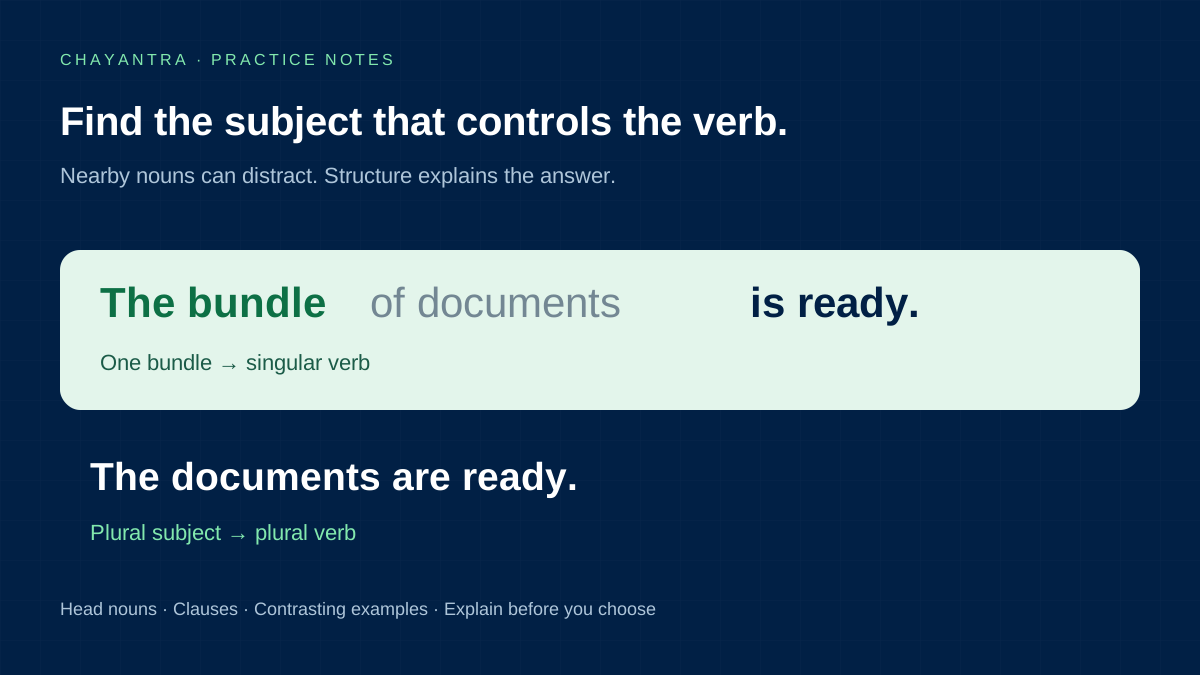
In standard edited English, the verb normally agrees in number with the subject: the form is ready; the forms are ready. In longer sentences, identify the subject phrase and its head noun before looking at nearby nouns. A plural noun inside a phrase does not automatically make the main subject plural.
This lesson develops one skill within the broader sentence-correction method. It uses original examples and a short diagnostic for English practice, including the English component of SSC CHSL preparation. It is not a claim that every grammar question follows one mechanical trick. Meaning, sentence structure and the variety of English used by a paper can matter.
Step 1: identify the main clause
Ask who or what the main verb describes. In “The bundle of documents is on the desk”, the main statement concerns the bundle. The words “of documents” describe its contents. Compare “The documents are on the desk”: the head noun is now plural.
Temporarily bracket extra material to inspect the structure: “The bundle [of documents] is on the desk.” Bracketing is a checking technique, not permission to delete words when interpreting meaning. Put the phrase back before choosing an answer.
Do not merely choose the noun closest to the verb. That approach fails when a phrase, relative clause or parenthetical description sits between the main subject and its verb.
Step 2: separate the main verb from a relative-clause verb
Consider “The folder that contains the forms is missing.” There are two subject–verb relationships: folder contains within the relative description and folder is in the main statement. Now compare “The folders that contain the forms are missing.” Both relevant verbs change because the subject is plural.
A more distracting example is “The folder containing several printed forms is missing.” The plural noun “forms” is part of the description; it does not control the main verb “is”. Explain the clause structure rather than counting plural endings.
If an option changes only one of several verbs, check each clause separately. Fixing the main verb does not automatically make the whole sentence grammatical. This is one reason the reading-evidence guide and careful sentence reading can support grammar work too.
Step 3: watch distributive words
“Each of the applicants is ready” presents applicants individually. The main subject is “each”, not the plural noun inside the following phrase. “Every form is checked” likewise treats each form individually.
Compare “The applicants are ready.” Removing the distributive expression changes the subject structure. Keep the whole phrase in view; do not memorise that any sentence containing the word “applicants” must take a plural verb.
In “Each applicant and each supervisor has a copy”, the repeated “each” gives the combined expression a distributive reading. Learn the construction through complete examples and check whether an actual question uses the same pattern.
Step 4: distinguish “a number” and “the number”
“A number of candidates are waiting” uses “a number of” to mean several candidates. “The number of candidates is increasing” discusses the count itself. The forms “are” and “is” reflect different meanings, not a contradiction in the rule.
When practising, write a short paraphrase: “Several candidates are waiting” versus “The count is increasing.” A paraphrase can reveal the subject that the sentence is presenting.
Do not apply this pattern to every noun followed by “of”. “A list of candidates is attached” refers to one list. The head noun and intended meaning still need to be identified.
Step 5: check coordinated subjects in context
Two separate people linked by “and” normally form a plural subject: “The clerk and the supervisor are present.” An expression naming one combined thing or idea can behave differently, so identify the meaning rather than treating “and” as an automatic answer key.
With “either … or” and “neither … nor”, the common proximity convention uses the nearer subject to guide agreement when the two differ in number. For these controlled examples: “Neither the clerk nor the officers are ready”; “Neither the officers nor the clerk is ready.” Such combinations can sound awkward; in ordinary writing, revising the sentence can be clearer.
For a test question, read all the options and any stated style conventions. Do not invent an exception merely to defend an answer that changes the sentence’s intended reference.
Step 6: avoid overcorrecting collective nouns and quantities
Collective nouns can vary with meaning and English variety. A team considered as one unit and members considered individually may be expressed differently. A blanket rule that “team always takes is” is too crude. Where an exam supplies one answer, check the sentence context and the explanation rather than generalising from one isolated example.
Quantities can also function as one unit: “Ten kilometres is a long walk.” The sentence presents one distance. Compare a context that treats items as separate objects. Ask what the sentence is measuring or grouping.
The aim is not to multiply exceptions. It is to use a clear structural explanation, then check meaning when a noun phrase permits more than one reading.
An original five-sentence diagnostic
Choose the suitable verb in each example, then explain the controlling subject.
- The list of required documents is / are attached.
- The documents in the blue folder is / are ready.
- Each of these examples shows / show a different pattern.
- A number of students has / have finished the exercise.
- The number of unanswered questions has / have fallen.
Answers and reasons: The first takes is, controlled by “list”. The second takes are, controlled by “documents”. The third takes shows, controlled by “each”. The fourth takes have, because “a number of students” means several students. The fifth takes has, because the subject concerns the number, or count.
If you chose the right answer only because it sounded familiar, write the explanation before marking the skill secure. Then change the example while preserving its structure and check your new sentence.
Choose practice that matches the size of the weakness
Use the English practice hub and the matching grammar sets on this page. The published Common Errors, Sentence Correction and Error Spotting sets cover broader grammar; they are not labelled as exclusively subject–verb agreement quizzes. Read their actual titles before starting.
Record the head noun, the distracting phrase and your corrected explanation in the English practice checklist. If the same cause appears in several attempts, keep one concise rule plus contrasting examples rather than a long list of copied answers.
When you can justify fresh examples independently, use the CHSL mock hub to see whether the skill survives mixed, timed practice. English lessons do not replace the Reasoning and Numerical Ability work required for an RRB Office Assistant prelims practice plan.
Questions before the next set
Should I always ignore prepositional phrases? No. Bracket them temporarily to inspect the main structure, then restore them and check meaning. They can contain information essential to interpretation.
Can the nearest noun ever control agreement? Yes, in particular structures such as the proximity convention described above. That does not make “choose the nearest noun” a general method.
How do I know I have learned the rule? Explain a new sentence’s subject and clause structure without seeing the solution, then justify the verb. A repeated question answered from memory is weaker evidence.