Percentage questions: identify the base before you calculate
A percentage compares a part or a change with a chosen whole. For a change from an original value to a new value, use change ÷ original value × 100. Before using a shortcut, write what represents 100%. This single step distinguishes a price increase, a discount, a profit percentage and a reverse-percentage question.
This guide uses original examples for SSC CHSL and related quantitative practice. It is a concept lesson, not an official paper or a claim about questions in a future shift. Begin with the worked examples, try the short diagnostic without looking at the answers, then choose a published percentages set. The SSC CHSL practice hub connects this work to full-paper practice when you are ready to mix skills.
The three values to label
Write down the original value, the new value and the difference. Then underline the reference value named by the question. “Increased by what percentage?” normally compares the increase with the original amount. “The original amount is what percentage of the new amount?” asks a different comparison.
| Question wording | Numerator | Denominator |
|---|---|---|
| Percentage increase | New − original | Original |
| Percentage decrease | Original − new | Original |
| A is what percentage of B? | A | B |
| What is p% of a quantity? | p × quantity | 100 |
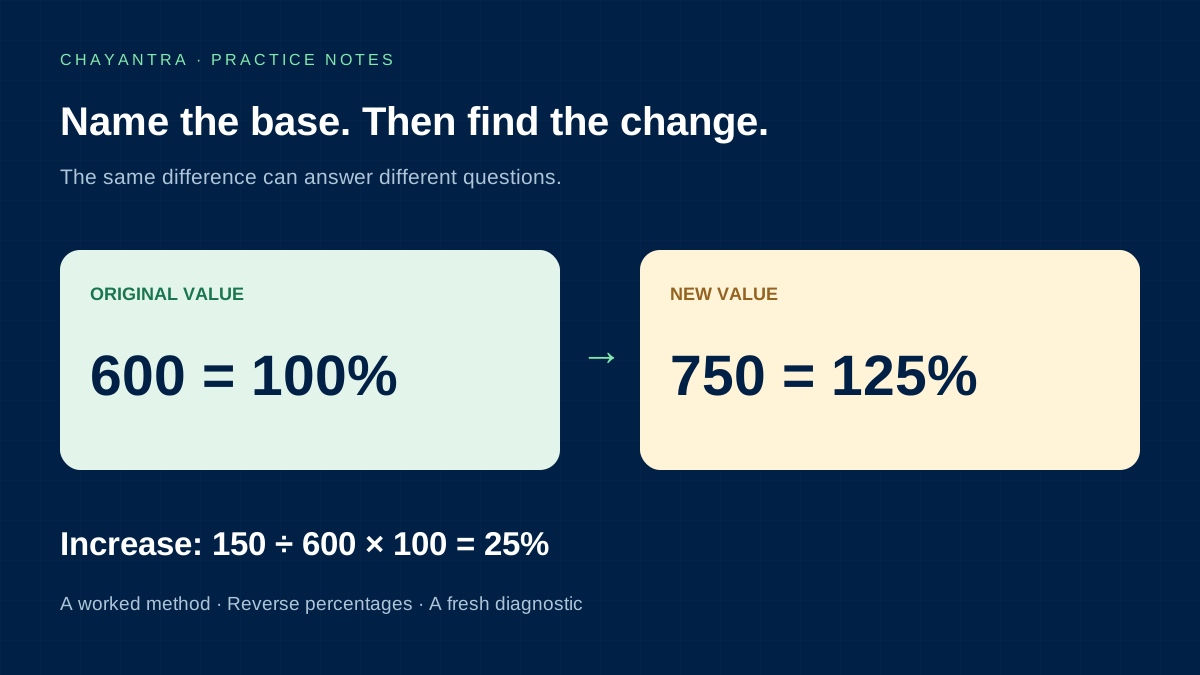
For example, a fee rises from ₹600 to ₹750. The difference is ₹150. The increase is 150 ÷ 600 × 100 = 25%. The same ₹150 is 20% of ₹750, but that is not the percentage increase. Both calculations are numerically valid; only one answers the question asked.
Why equal increases and decreases do not cancel
Suppose a quantity of 200 increases by 10%. It becomes 200 × 1.10 = 220. A later decrease of 10% uses 220 as its base: 220 × 0.90 = 198. The final value is 2 below the original 200, a 1% decrease overall.
The percentage rates are equal, but the amounts are different: the increase is 20 and the decrease is 22. Do not combine changes simply by adding signed percentages when each stage acts on a changed quantity. Multipliers make the base change visible.
For an increase of p%, multiply by 1 + p/100. For a decrease of p%, multiply by 1 − p/100. These multipliers apply to changes in the same quantity, stage by stage. They do not automatically combine percentages belonging to unrelated groups or measurements.
Successive changes, worked carefully
A value of 800 increases by 20% and then decreases by 15%. Its final value is 800 × 1.20 × 0.85 = 816. The combined multiplier is 1.02, so the net change is 2% up, not 5% up.
You can verify the result in two stages: 20% of 800 is 160, giving 960; 15% of 960 is 144, leaving 816. In practice, use whichever method you can explain reliably. A shortcut is useful only when you know which quantities it combines.
Write one intermediate value when reviewing mistakes. If your final answer is wrong, that value helps distinguish an incorrect model from a multiplication slip. The mock-test error log includes space for the cause and the next correction.
Reverse percentages: work back through the multiplier
If a price after a 20% discount is ₹960, then ₹960 represents 80% of the marked price. Write 0.80 × marked price = 960. The marked price is 960 ÷ 0.80 = ₹1,200.
Adding 20% to ₹960 gives ₹1,152 and does not reverse the discount. The discount used the larger original base. To restore 960 to 1,200 requires an increase of 240 ÷ 960 × 100 = 25%. This is why a decrease of p% and an increase of p% are not inverse operations.
For a 12% increase leading to 560, the original amount is 560 ÷ 1.12 = 500. Substitute your answer into the forward operation before moving on: 500 × 1.12 = 560. This check is quick and catches many misplaced-base errors.
Percentage points are different from percentage change
If accuracy moves from 40% to 50%, the difference is 10 percentage points. Relative to the original accuracy, the increase is 10 ÷ 40 × 100 = 25%. State which measure you mean.
In your own study log, keep the counts as well: 8 correct out of 20 and 10 correct out of 20 are easy to interpret. Comparisons are less meaningful when difficulty, question count or repeated-question familiarity changes substantially. A percentage alone does not explain whether your method improved.
A short diagnostic
Try these original questions before reading the worked answers. For each, write “100% means ___” first.
- A price increases from ₹480 to ₹600. Find the percentage increase.
- After a 25% reduction, a value is 450. Find the original value.
- A quantity increases by 10% and then by 20%. Find the overall percentage increase.
- A test accuracy rises from 60% to 72%. State both the percentage-point change and the relative percentage increase.
Answers: The first increase is 120 ÷ 480 × 100 = 25%. In the second, 450 is 75% of the original, so 450 ÷ 0.75 = 600. For the third, 1.10 × 1.20 = 1.32, giving 32%. In the last, the change is 12 percentage points, or 12 ÷ 60 × 100 = 20% relative to the original accuracy.
Turn the result into the next practice task
If you chose the wrong denominator, practise naming the base without calculating. If your setup was right but arithmetic failed, work on the fraction or multiplier involved. If you solved accurately without time pressure, try a short timed set and see whether the same reasoning survives.
Use the matching percentages links on this page or the topic-test directory. Check the actual set title, difficulty and instructions; a short percentages quiz is not a complete SSC CHSL mock. When the method is stable, return to the CHSL mock hub and the seven-day revision planner.
Questions learners often ask
Which value goes in the denominator? The reference whole. For percentage change, that is the original value; for a discount it is the marked price; for profit percentage it is normally cost price. Read the exact wording and any alternative basis specified.
Should I memorise fraction equivalents? They can make calculation quicker, but first show why the fraction applies. Recognising 25% as one quarter does not help if you take a quarter of the wrong quantity.
What should I study next? Apply the same base-selection method to profit, marked price and discount. Keep percentage-point comparisons separate from those price calculations.