Profit and loss: separate cost price, marked price and selling price
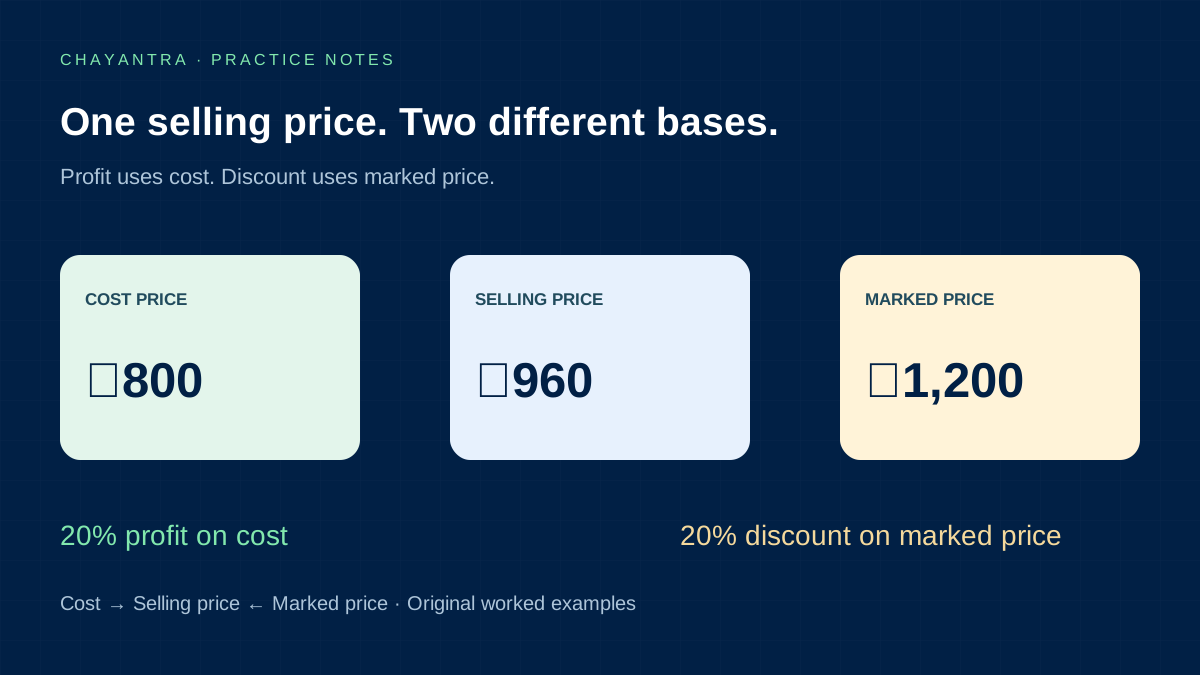
Use cost price as the usual base for profit or loss percentage, and marked price as the base for a discount. The selling price connects the two calculations. A 20% discount and a 20% profit can both occur in one transaction because they refer to different amounts.
This guide gives original worked examples for quantitative practice, including SSC CHSL and relevant IBPS RRB preparation. It is not an official question paper or a prediction. The calculations use the simple cost specified in each problem; real business margins can involve additional costs and accounting conventions. In an exam-style question, follow its stated assumptions and any explicitly different percentage basis.
Label the transaction before using formulas
Let CP mean cost price, MP marked price and SP selling price. Write the three labels beside the numbers before calculating. If there is a discount, the marked amount and the selling amount are different. If a question mentions expenses, decide whether it includes them in the relevant cost before applying a percentage.
| Quantity requested | Calculation under the usual stated-cost convention |
|---|---|
| Profit amount | SP − CP |
| Loss amount | CP − SP |
| Profit percentage | Profit ÷ CP × 100 |
| Loss percentage | Loss ÷ CP × 100 |
| Discount percentage | (MP − SP) ÷ MP × 100 |
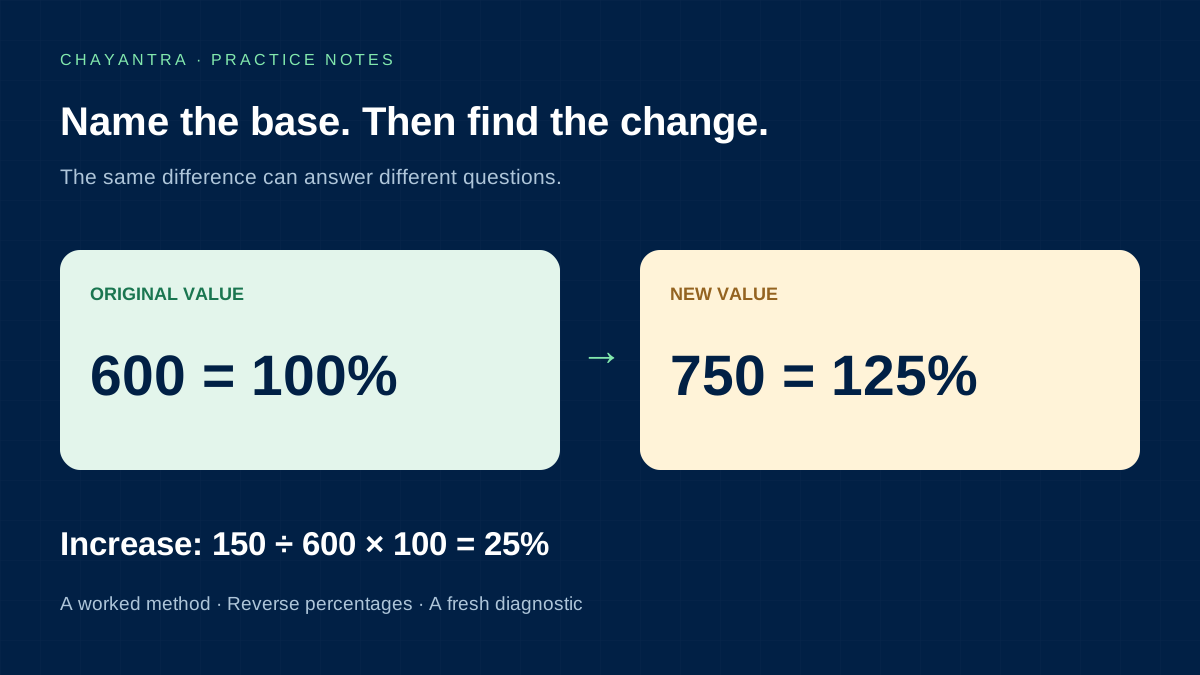
Avoid treating every percentage in the question as a change from CP. For a refresher on choosing the reference whole, use percentage questions and base values.
Example 1: profit and discount in the same sale
An item costs ₹800, is marked at ₹1,200 and sells for ₹960. The discount is 1,200 − 960 = ₹240. Relative to MP, that is 240 ÷ 1,200 × 100 = 20%.
The profit is 960 − 800 = ₹160. Relative to CP, that is 160 ÷ 800 × 100 = 20%. Equal rates here do not make discount and profit the same concept. You used two different bases: ₹1,200 for the discount and ₹800 for the profit.
A useful check is to calculate SP both ways: 1,200 × 0.80 = 960 and 800 × 1.20 = 960. If those values disagree, inspect the setup before trying another shortcut.
Example 2: find the selling price needed for a target profit
Suppose CP is ₹750 and the required profit is 12%. The desired selling price is 750 × 1.12 = ₹840. If the marked price is ₹1,050, the allowed discount amount is 1,050 − 840 = ₹210. The discount rate is 210 ÷ 1,050 × 100 = 20%.
Notice the order: calculate the necessary SP from CP, then compare that SP with MP. Subtracting 12% from the marked price would mix the bases and answer a different question.
When reviewing an error, write which link failed: CP to target SP, or MP to discounted SP. “Profit and loss is weak” is too broad to guide the next exercise. The editable error log helps turn the mistake into a specific action.
Example 3: recover the cost price
An item sells for ₹1,260 at a profit of 5% on cost. Write SP = 1.05 × CP. Then CP = 1,260 ÷ 1.05 = ₹1,200.
Subtracting 5% of ₹1,260 gives ₹1,197, which is incorrect because the profit was not defined as 5% of SP. Check the recovered value: 5% of 1,200 is 60; adding 60 gives 1,260.
For a loss of 8%, the multiplier from CP to SP is 0.92. If SP is ₹736, then CP is 736 ÷ 0.92 = ₹800. Explain which value represents 100% before doing the division.
Example 4: successive discounts
Two discounts of 20% and 10% on a marked price do not combine to 30%. After the first discount, 80% of MP remains. After the second, 90% of that remaining amount remains. The combined multiplier is 0.80 × 0.90 = 0.72, so the total discount is 28%.
On MP ₹1,500, the selling price is 1,500 × 0.72 = ₹1,080. Check the stages: the first reduction gives 1,200 and the second removes 120. You remove 420 in total, not 450.
This multiplier method handles successive changes to the same price. Do not use it to combine discounts on separate unrelated purchases unless the question defines an appropriate common total.
Example 5: the same selling price does not mean equal costs
Two items sell for ₹600 each. The first sale has a 20% profit and the second a 20% loss, both measured on their respective costs. The first CP is 600 ÷ 1.20 = ₹500; the second is 600 ÷ 0.80 = ₹750.
Total cost is ₹1,250 and total selling price is ₹1,200. The total loss is ₹50, or 50 ÷ 1,250 × 100 = 4%. You cannot cancel the equal percentage rates because they act on unequal cost bases.
Try four fresh questions
- CP is ₹500 and SP is ₹575. Find the profit percentage.
- MP is ₹900 and the discount is 15%. Find SP.
- An item sells for ₹1,104 at an 8% loss on cost. Find CP.
- Two successive discounts are 10% and 10%. Find the overall discount rate.
Worked answers: Profit in the first question is 75 ÷ 500 × 100 = 15%. The second SP is 900 × 0.85 = ₹765. In the third, 1,104 represents 92% of CP, so CP = 1,104 ÷ 0.92 = ₹1,200. In the fourth, 0.90 × 0.90 = 0.81 remains, giving a 19% discount.
If your answer is wrong, identify the relationship you wrote before checking the arithmetic. Re-solving a copied example from memory is not the same as choosing the right relationship in an unfamiliar problem.
Move from a concept to a timed set
Choose a published Profit and Loss set from the matching links below or the topic-test directory. Work without a timer first if the bases remain unclear. Once the method is stable, practise a short timed set and record whether errors came from modelling, arithmetic or question selection.
For combined SSC practice, use the CHSL mock hub. For the RRB Office Assistant context, read the prelims practice-and-review plan and check the role and stage of each available paper. A standalone arithmetic set supplements those papers; it does not cover the full exam syllabus.
Common questions
Is profit percentage always based on cost? That is the usual convention in these examples. A question can explicitly ask for profit as a percentage of selling price or specify another basis; follow that wording.
Do discount and loss mean the same thing? No. Discount compares a marked and selling price. Loss compares cost and selling price. An item can be discounted and still sold at a profit.
Which shortcut should I learn first? Start with multipliers and forward substitution. A formula is useful when you can name its assumptions and check its result independently.